

Explore Islam
The Holy Qur’an
Muslims believe the Arabic Qur’an to be God’s final revelation to humanity. Here’s a brief introduction to the Noble Qur’an.
An invitation to worship One God
According to the Islamic tradition, the Qur’an came down to Prophet Muhammad ﷺ, peace be upon him, through archangel Gabriel – Jibril in Arabic. The revelation came over a timespan of 23 years.
Here are the very first verses revealed to Prophet Muhammad ﷺ by Jibril on Mount Hira, a small mountain outside Makkah where the Prophet ﷺ used to go into a retreat.
“Recite: in the Name of your Lord Who created,
created man from clots of blood.
Recite: And your Lord is the Most Generous,
He who taught by the pen,
taught man what he did not know.”
Surah Al-‘Alaq, the Clot (verses 1-5)
The Oneness of God is the core message of the Qur’an. It invites people to worship Him alone – without any partner.
It appeals to reason, talks of good and evil, warning about the Day of Judgement when all mankind will be called to account for their beliefs and deeds in front of God Almighty.
Unique recitation
The Qur’an is a linguistic miracle – it has no comparison in its rhythmic and poetic eloquence in Arabic literature. As a phenomenon, the Qur’an is also unique in the way it is recited. The Arabic word Qur’an literally means recitation.
Qur’anic recitation is an advanced form of art and science called Tajweed. Muslims reciting the Qur’an should aspire to recite verses in a melodious voice according to the rules of Tajweed. Mastering Tajweed can literally take years of hard dedication.
When the Qur’an is translated to other languages, it always loses its distinctive sound and eloquence. The Qur’an therefore isn’t just meant to be read – it’s also meant to be heard as the speech of God. This is why the Qur’an is largely an Arabic phenomenon.
It is said that the Qur’an is a healing for the hearts and minds. Listening to the Qur’an can have a soothing effect, even if the listener doesn’t know Arabic.
Before starting reciting the Qur’an, believers purify themselves with the ritual ablution using water. After that in-line with the Prophetic tradition, they seek refuge from the accursed devil and then start in the name of Allah, Most Gracious Most Merciful, which is always the opening verse of every chapter.
Listen here to Surah Al Fatiha, The Opening, which is the first chapter of the Qur’an. Al Fatiha is recited during each of the daily prayers.
“In the Name of Allah, All-Merciful, Most-Merciful.
Praise be to Allah, the Lord of all the worlds,
the All-Merciful, the Most-Merciful,
The King of the Day of Repayment.
You alone we worship. You alone we ask for help.
Guide us on the Straight Path,
the Path of those You have blessed,
not of those with anger on them, nor of the misguided.”
Daily companion and guide
The Qur’an plays a special role in the lives of Muslims. In it the believer can find meaning and explanations regarding the trials of their own lives. Through the various Prophetic stories, the Qur’an provides guidance giving the believers strength and faith to carry on through the ups and downs of life.
The Qur’an also contains recently proven scientific miracles, such as the detailed description of the human embryo. For believers, these are all proofs that the illiterate Prophet Muhammad ﷺ couldn’t possibly have been the author of the Qur’an.
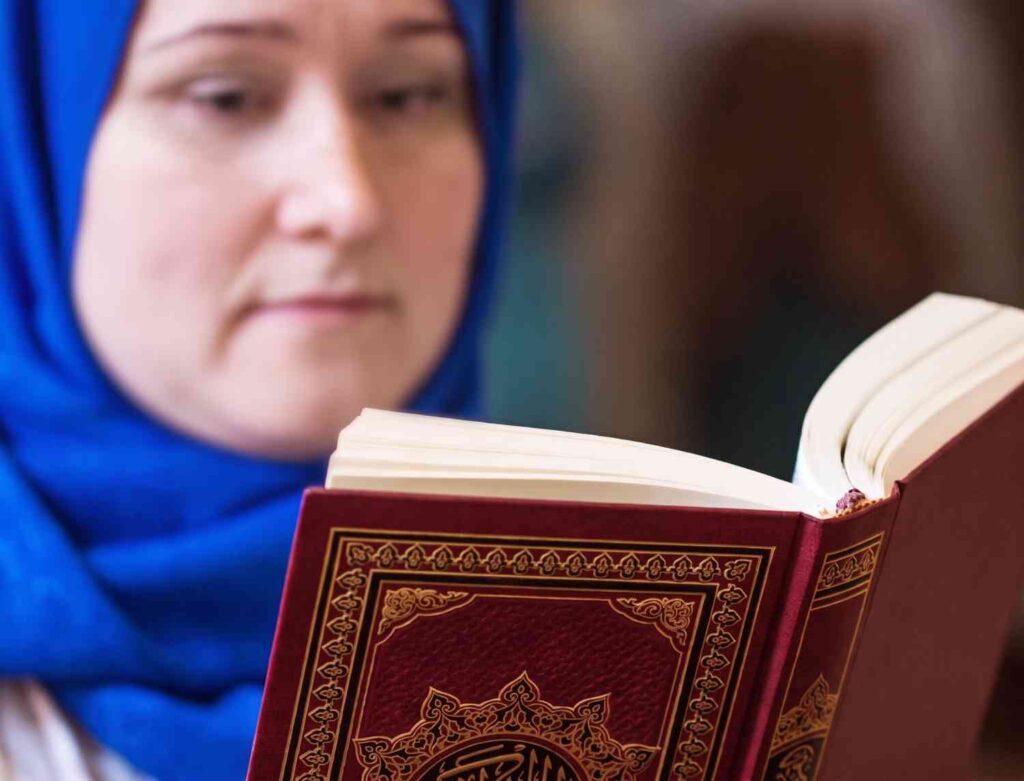
A worshipper reading the Holy Qur’an at Turku Mosque.
Memorisation
Each time the Prophet received and conveyed a verse, he instructed his followers to write it down. These written compilations were preserved and later collated into a book by Caliphs Abu Bakr and Othman, the leaders of the early Islamic community after the death of the Prophet ﷺ.
In addition to early written records, many of the Prophet’s ﷺ followers knew the Qur’an by heart. This tradition of memorizing the Qur’an is still practiced today by Muslims around the world. A person who has memorized and can recite the Qur’an by heart is known as hafidh – a guardian of the Qur’an.
This ongoing practice of memorization together with the preservation of early written forms have prevented any corruption to the Holy Book. This is why the Noble Qur’an still exists in its original form today. In other words, the Qur’an is still in its pure original form.
Interpreting the Qur’an: tafseer
The key to fully understanding the message of the Qur’an is the Arabic language. Only through understanding the linguistic nuances of Arabic can the true beauties of the Qur’an be revealed.
However, knowledge of Arabic is only the beginning. According to the over 1400-year Islamic scholarly tradition, the interpretation of the Qur’an is based on an in-depth knowledge of the text and its historical context.
This interpretation of the Qur’an is its own science known as tafseer. In classical Islam learning the tafseer of the Qur’an is a rigorous process that takes several years, even decades, to master.
The Qur’an came down to a people in a specific historical circumstance. Each Qur’anic verse therefore has its own historical setting and story behind it, that should be learned by one who is studying tafseer.
“The interpretation of the Qur’an is based on an in-depth knowledge of the text and its historical context.”
Interpretations and explanations of later Muslim scholars, known in Arabic as the ulama, constitute to a vast body of tafseer literature that similarly need to be mastered by the person attempting to interpret the Qur’an.
The scholar of tafseer needs to be also well versed with the tradition of Islam as a whole. Here the example of the Prophet Muhammed ﷺ, known as the sunnah, plays a central role.
The sunnah consists of a similarly expansive body of knowledge called hadith literature and knowing the amal, the practice of the people who followed him. This is a separate Islamic science on its own right.
While the Qur’an was sent for all times and places, Islamic scholarship plays a crucial role in enabling the community of believers to remain faithful to the original sources.
This is why classical Islamic scholarship is meant to be a living and a breathing intellectual tradition.
Learn more
For questions about Islam or arranging a mosque visit, please contact Turku Islamic Society.
Learn more

